| ||
| Visit MustangSteve's web site to view some of my work and find details for: FYIFORD Contributors' PICTURES - Power Brake Retrofit Kits for 65-66 Stangs - Classic Mustang FAQ's by MustangSteve - How to wire in a Duraspark Ignition - Mustang Ride Height Pictures and Descriptions - Steel Bushings to fit Granada Spindles to Mustang Tie Rods - Visit my EBAY store MustangSteve Performance - How to Install Granada Disc Brakes MustangSteve's Disc Brake Swap Page - FYIFORD Acronyms for guide to all the acronyms used on this page - FYIFORD Important information and upcoming events |
Offline
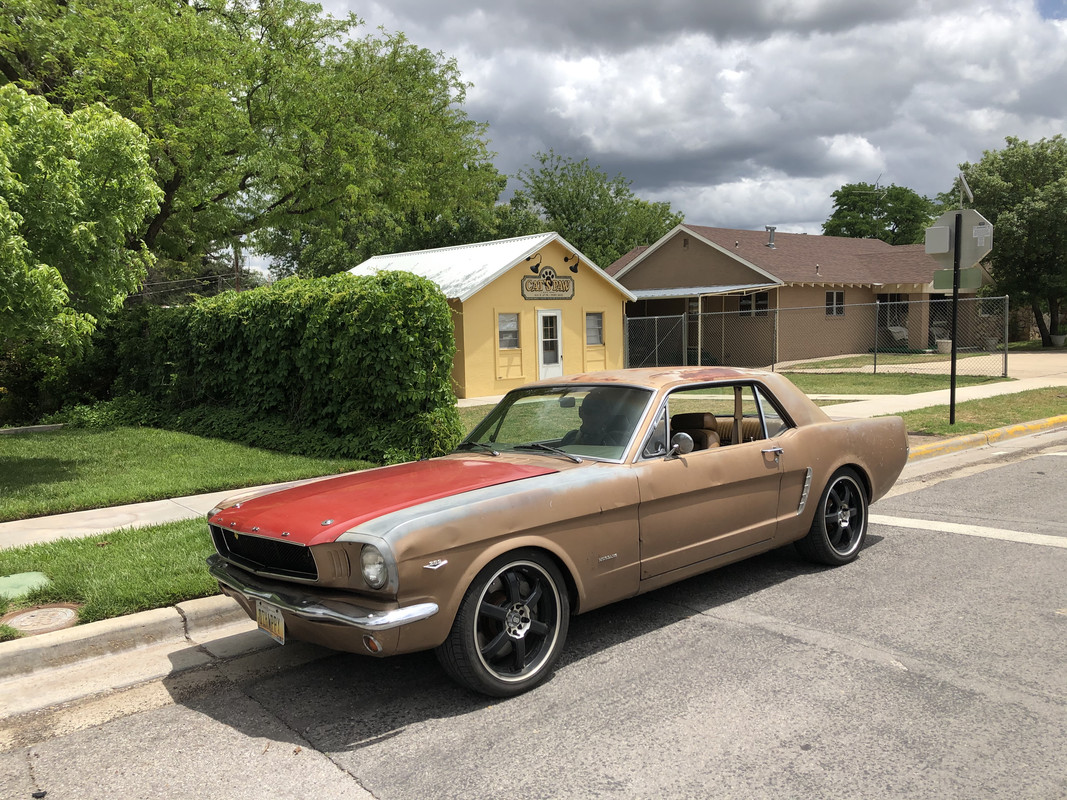
Hey y’all! Been an awhile. I need some expert advice on tire size. I’ve been running a 235/45/17 tire on my 66. I’ve done the “Shelby drop” and have 620 lowering springs. With a proper alignment it handles pretty good. My question is if I were to go to a 225/45/17 would it improve my handling noticeably?
Offline

That is exactly what I did in my 66. I believe it handles and steers more precise
Offline

A narrower tire will “hunt” less in wheel path ruts.
Offline
Wide tires are kind of a crutch for a car that doesn't handle well in my experience. The best handling car I own is my WRX and it runs a 205 tire. It sticks to the road like its on rails. Wider tires may improve straight line traction, but IME they often don't do what one would expect for corner carving. I think vehicle weight may play a role in it as well. Heavier cars inherently don't handle as well, so they get by with wider tires. Classic Mustangs, like my WRX, are light, so a well set up suspension and good alignment are going to go far farther than another 10mm worth of tread width.
Offline

The more rubber you can fit, the better the car will handle. It's simple physics.
Last edited by rpm (8/01/2025 11:50 AM)
Offline
rpm wrote:
The more rubber you can fit, the better the car will handle. It's simple physics.
It depends on how you define handling. Straight line traction will improve, which should benefit acceleration and braking. If you put the car on a skid pad it would improve (pull more Gs). BUT a truer measure of handling is a slalom, or road course times. Wider tires don't necessarily improve those, because they have more to do with how the car transitions, and transition is 90% of handling IMO. Wider tires don't make the suspension react faster, they don't increase roll stiffness, the don't change spring rate, etc.
Offline

The bigger the rubber patch on the road surface, the more grip you will have, regardless of your suspension. The more grip you have, the faster you can take a corner.
Offline

Tires by different manufacturers can have same “tire size” and physically measure different in “real world” size.
For example, the Pirelli’s I had previously (235/40/18) had a slightly smaller section width at 9” and tread width as compared to the Goodyear’s (235/40/18) section width at 9.25”.
Even the BFG T/A Radials (235/60/14) had a section width of 9.25”.
Something to consider. I learned this lesson many years ago.
As they say, “Size matters” 😁
Offline

Food for thought...
A 3,000 pound car, with four tires, each set at 30 psi, will have a contact patch of 25 square inches, no matter what size tire or rim size, bias or radial. It takes 25 square inches times four for 30 psi to support 3,000 pounds of weight. (for this example, car has 50-50 weight distribution)
For a wider tire, the contact patch will be wider than it is front-to-back. For a 6.95-14 bias tire, the patch will be much larger front-to-back than it is wide. But, those contact patches will always equal 25 square inches.
A tire with a shorter sidewall will require less steering effort than a tire with a taller sidewall, (or, will it?)
Offline
My 65 has 245/45/17 all around. With the exception of one I havent lost traction in any corner but… it tends to feel like it wants to wander. My 67 was running 225/50/16 on all four and always felt like it was going where i wanted to put it, but it was easier to lose grip.
I think the skinnier tires are better for daily driving.
Btw just for fun. I had a 15mph right hand followed by an immediate 15 mph left hand turn on the street to my work some years ago. And I would sometime slalom my cars and record how fast i could take it.
1998 mazda protege 38mph (stock) 195/70/14
2005 infiniti g35 S model 55mph (needed to correct oversteer) 235/275/19 staggered
1965 convertible shelby drop, 245/45/17 all 4 and hd suspension….. 50mph (massive frame twisting, top down) the only car to not lose traction.
My 67 pushed like the infiniti, probably did 45 to 47 hard to tell because the speedo was wonky, but of all my cars its the smoothest driving
Offline

MS wrote:
Food for thought...
A 3,000 pound car, with four tires, each set at 30 psi, will have a contact patch of 25 square inches, no matter what size tire or rim size, bias or radial. It takes 25 square inches times four for 30 psi to support 3,000 pounds of weight. (for this example, car has 50-50 weight distribution)
For a wider tire, the contact patch will be wider than it is front-to-back. For a 6.95-14 bias tire, the patch will be much larger front-to-back than it is wide. But, those contact patches will always equal 25 square inches.
A tire with a shorter sidewall will require less steering effort than a tire with a taller sidewall, (or, will it?)
Now why ya gotta bring in math to our discussion??? 😂
Offline

rpm wrote:
MS wrote:
Food for thought...
A 3,000 pound car, with four tires, each set at 30 psi, will have a contact patch of 25 square inches, no matter what size tire or rim size, bias or radial. It takes 25 square inches times four for 30 psi to support 3,000 pounds of weight. (for this example, car has 50-50 weight distribution)
For a wider tire, the contact patch will be wider than it is front-to-back. For a 6.95-14 bias tire, the patch will be much larger front-to-back than it is wide. But, those contact patches will always equal 25 square inches.
A tire with a shorter sidewall will require less steering effort than a tire with a taller sidewall, (or, will it?)
Now why ya gotta bring in math to our discussion??? 😂
You started it
Offline
rpm wrote:
The bigger the rubber patch on the road surface, the more grip you will have, regardless of your suspension. The more grip you have, the faster you can take a corner.
Yes, exactly, A corner. That's a skidpad interpretation of handling. Now try taking multiple corners of different direction one immediately after the other. That's slalom. What you'll find is that the size of the tires is far less important than how fast the suspension reacts and how good a job it does of keeping whatever tires are on the car in contact with the road as the weight transfers from side to side. When I used to read Road and Track I'd look at the two numbers and you'd be surprised how often a car that pulled great in the skidpad had a lackluster slalom performance. These were also almost always cars that had really wide tires. Meanwhile a car with skinnier tires may not perform as well on the skidpad, but did very well in the slalom, which is a far more real world test of handling. Is some of it apples to oranges? Sure, but the overall message is still valid. Wider tires are at best a crutch for a car that's probably too heavy and has a less than stellar suspension setup. Lighter cars inherently handle better because there's less weight to control, and they don't need the crutch of the widest tires that can possibly fit to handle really well.
Offline

MS wrote:
Food for thought...
A 3,000 pound car, with four tires, each set at 30 psi, will have a contact patch of 25 square inches, no matter what size tire or rim size, bias or radial. It takes 25 square inches times four for 30 psi to support 3,000 pounds of weight. (for this example, car has 50-50 weight distribution)
For a wider tire, the contact patch will be wider than it is front-to-back. For a 6.95-14 bias tire, the patch will be much larger front-to-back than it is wide. But, those contact patches will always equal 25 square inches.
A tire with a shorter sidewall will require less steering effort than a tire with a taller sidewall, (or, will it?)
How does the math work when the weight is 60/40?
Every else remains the same of course.
Referring to contact patch.
Last edited by Nos681 (8/03/2025 5:54 AM)
Offline

Nos681 wrote:
MS wrote:
Food for thought...
A 3,000 pound car, with four tires, each set at 30 psi, will have a contact patch of 25 square inches, no matter what size tire or rim size, bias or radial. It takes 25 square inches times four for 30 psi to support 3,000 pounds of weight. (for this example, car has 50-50 weight distribution)
For a wider tire, the contact patch will be wider than it is front-to-back. For a 6.95-14 bias tire, the patch will be much larger front-to-back than it is wide. But, those contact patches will always equal 25 square inches.
A tire with a shorter sidewall will require less steering effort than a tire with a taller sidewall, (or, will it?)
How does the math work when the weight is 60/40?
Every else remains the same of course.
Referring to contact patch.
The contact patch at the 60 end becomes 60% snd the 40 end becomes 40%
The dynamics of cornering, which add dynamic loading of the tires will increase the patch size, just like it does to a fighter jet pilot’s backsides as g forces increase.
Offline

How does one calculate the contact patch with the change in weight?
Is it theoretically proportional?
Does a larger front tire help in braking as well?
Offline

TKOPerformance wrote:
rpm wrote:
The bigger the rubber patch on the road surface, the more grip you will have, regardless of your suspension. The more grip you have, the faster you can take a corner.
Yes, exactly, A corner. That's a skidpad interpretation of handling. Now try taking multiple corners of different direction one immediately after the other. That's slalom. What you'll find is that the size of the tires is far less important than how fast the suspension reacts and how good a job it does of keeping whatever tires are on the car in contact with the road as the weight transfers from side to side. When I used to read Road and Track I'd look at the two numbers and you'd be surprised how often a car that pulled great in the skidpad had a lackluster slalom performance. These were also almost always cars that had really wide tires. Meanwhile a car with skinnier tires may not perform as well on the skidpad, but did very well in the slalom, which is a far more real world test of handling. Is some of it apples to oranges? Sure, but the overall message is still valid. Wider tires are at best a crutch for a car that's probably too heavy and has a less than stellar suspension setup. Lighter cars inherently handle better because there's less weight to control, and they don't need the crutch of the widest tires that can possibly fit to handle really well.
Indy cars, F1 cars, and a plethora of others are pretty light. Not a one uses a smaller tire than what the maximum tire width in the rules allows. If smaller tires were faster, they would use them. Sheesh...Later.
Offline

Welp (thx RPM).....IF 'wider ain't bedder' (AFA handling goes) somebody bedder tell those NASCAR sissies and F-1 car guyz
Me tinkz
6sally6.
Offline

6sally6 wrote:
Welp (thx RPM).....IF 'wider ain't bedder' (AFA handling goes) somebody bedder tell those NASCAR sissies and F-1 car guyz
Me tinkz
6sally6.
Ed Zachary.
Offline
rpm wrote:
TKOPerformance wrote:
rpm wrote:
The bigger the rubber patch on the road surface, the more grip you will have, regardless of your suspension. The more grip you have, the faster you can take a corner.
Yes, exactly, A corner. That's a skidpad interpretation of handling. Now try taking multiple corners of different direction one immediately after the other. That's slalom. What you'll find is that the size of the tires is far less important than how fast the suspension reacts and how good a job it does of keeping whatever tires are on the car in contact with the road as the weight transfers from side to side. When I used to read Road and Track I'd look at the two numbers and you'd be surprised how often a car that pulled great in the skidpad had a lackluster slalom performance. These were also almost always cars that had really wide tires. Meanwhile a car with skinnier tires may not perform as well on the skidpad, but did very well in the slalom, which is a far more real world test of handling. Is some of it apples to oranges? Sure, but the overall message is still valid. Wider tires are at best a crutch for a car that's probably too heavy and has a less than stellar suspension setup. Lighter cars inherently handle better because there's less weight to control, and they don't need the crutch of the widest tires that can possibly fit to handle really well.
Indy cars, F1 cars, and a plethora of others are pretty light. Not a one uses a smaller tire than what the maximum tire width in the rules allows. If smaller tires were faster, they would use them. Sheesh...Later.
Smaller wheels ARE faster in a straight line, but unfortunately they don't grip the road as well laterally. Think about it, less rolling resistance, less weight. BUT, in such forms of racing its a very different animal, and we would also be talking about all things being equal. Those cars all have as much power as possible, are as light as possible, and of course use the widest tire possible. Those cars are also traveling what 220MPH and pulling over 5Gs in the corners. The suspensions are perfectly tuned and react instantaneously. To be competitive in that world you MUST use every advantage, and hope either your driver is better or you found something others didn't that skirts the rules.
I'm talking more about when things are not equal. If I took the same car and had the option to improve the suspension or just slap wider tires on it I'd chose the former every time. So I don't think 1/2" wider tires are worth the hassle if they don't really fit. I'd just choose to make the car handle better, rather than crutch poor handling with more lateral grip.
Last edited by TKOPerformance (8/04/2025 5:53 AM)
Offline
But, but Bigger Tires look better.
Offline

Mach1Driver wrote:
But, but Bigger Tires look better.
Good one Terry. In my opinion, nothing looks better on a classic Mustang, especially a 69, is a 15x8 inch wheel with enough rubber on the road for traction 😁 and sidewall to fill the wheelhouse. Butt I just had to put on bigger brakes, and wheels, and tires, and down the rabbit hole I went. Did you get your Mach 1 painted yet?
Offline

BillyC wrote:
Hey y’all! Been an awhile. I need some expert advice on tire size. I’ve been running a 235/45/17 tire on my 66. I’ve done the “Shelby drop” and have 620 lowering springs. With a proper alignment it handles pretty good. My question is if I were to go to a 225/45/17 would it improve my handling noticeably?
Did ya even wear out the existing tires yet?
What happened to your front wheel to caliper issue?
Inquiring minds want to know.
Last edited by Nos681 (8/04/2025 11:02 AM)
Offline

Billy C different than BILLY WALTON
Offline

True.
Sorry Bill.
| REMEMBER!!! When posting a question about your Mustang or other Ford on this forum, BE SURE to tell us what it is, what year, engine, etc so we have enough information to go on. |